

Three weekend breaks sound like more holiday than one long one. Often they are not. One big trip can beat three small ones because you pay for flights and transfers once, lose fewer days to travelling, and stay long enough to properly switch off. The catch is that it needs a plan: one budget, one block of leave, and a slow route.
This guide shows you how to plan one big trip from start to finish. You will learn how to add up your holiday budget, choose a destination that deserves the time, build a relaxed itinerary, and book things in the right order. You will also see when three short breaks are still the smarter choice, because one long holiday does not suit everyone.
Quick Facts
- Fixed costs happen once. One long trip means one return flight and one set of airport transfers, not three.
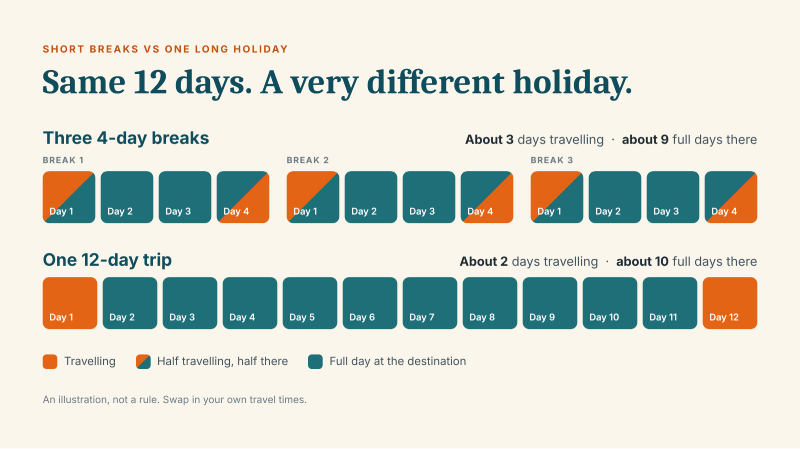
- Travel days shrink. Three 4-day breaks can use up about three days in transit. One 12-day trip often uses two.
- Planning is part of the fun. A 2010 Dutch study of 1,530 people found that those with a holiday ahead were happier than those without one, possibly because they were looking forward to it.
- Relaxed trips work best. In the same study, only very relaxed holidays lifted happiness after people came home.
- Three nights per stop is a good minimum. With fewer, you spend the trip packing.
- Passports need early attention. Many countries ask for several months of validity beyond your travel dates, so check the official rules before you book.
- Short breaks still have a place. They suit people who cannot take long leave or who prefer regular rests.
Why One Big Trip Can Beat Three Small Ones
A big trip is not just a longer version of a short one. It changes how your money and your days get used. Here are the four main reasons it often comes out ahead.
You Pay the Fixed Costs Once
Every trip has costs that do not depend on how long you stay. Think of flights, airport taxis, visa fees, pet sitters and travel insurance. Take three trips and you pay most of these three times.
On one long holiday, that money goes further. You can put the savings into a better room, a special meal or an experience you would normally skip. A longer stay can also unlock weekly rates at apartments and guesthouses.
You Lose Fewer Days to Travelling
A short break is mostly edges. You arrive tired on day one and start packing on the last morning. On a four-day trip, that can leave only two and a half real days.
A long trip has the same two travel days, but they are a much smaller share of the whole. On a 12-day holiday, you still get around ten full days on the ground. This matters even more for far-away places, where the flight alone can take most of a day.
You Can Travel Slowly and Go Deeper
Slow travel means staying longer in fewer places. Instead of rushing through a checklist, you get to know one area well. You find a favourite café, learn the bus routes and stop looking at the map.
Some places only make sense with time. A road trip through New Zealand, a rail journey across Japan or a loop through northern Italy cannot fit into a long weekend. One big trip puts these “someday” destinations within reach.
You Get Months of Looking Forward
A big trip gives you something to look forward to for a long time. You read about the place, save for it and talk about it with the people coming along. That build-up is a real part of the holiday.
Research points the same way. In the Dutch study mentioned above, people waiting for a holiday reported higher happiness than people with no trip planned. A trip you plan for six months gives you much more time to enjoy that feeling than one you book on Thursday for Friday.
When Are Three Short Breaks the Better Choice?
One big trip is not right for everyone. Short breaks win when you cannot take more than a few days off at once, or when a long absence from work would cause you stress.
They also suit families with very young children, who often cope better with short journeys. And if you get tired or homesick after a week away, a long holiday may feel like hard work.
There is one more point to weigh. The Dutch study also found that, after the holiday, most travellers were no happier than people who had stayed home. If you need regular rests to get through the year, three small trips spread that relief out. A good middle path is one big trip plus a few low-cost day trips close to home.
How to Plan One Big Trip: Step by Step
Good planning turns a long holiday from a risk into a reward. Follow these six steps in order. Each one makes the next decision easier.
Step 1: Add Up Your Real Holiday Budget
Start with what you already spend. Write down the cost of your last few short breaks, including flights, hotels, food and taxis. Add them up. That total is your starting budget for one big trip.
Many people are surprised by this number. Three “cheap” weekends can cost as much as one proper holiday. If the total is still short, decide how much you can add each month until you leave.
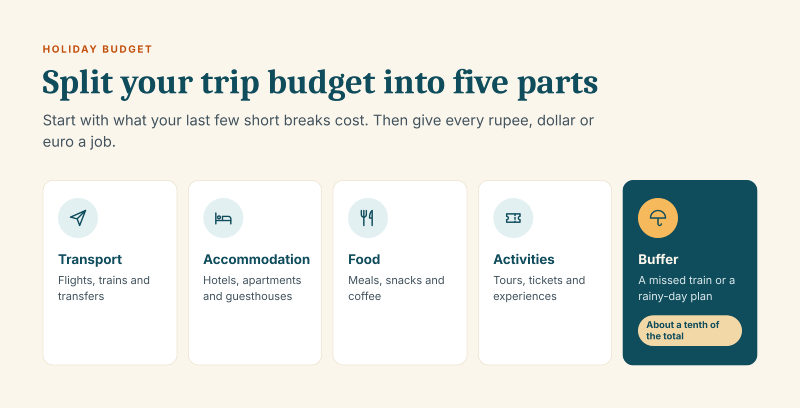
Then split the holiday budget into five simple parts: transport, accommodation, food, activities and a buffer. Keep the buffer at roughly a tenth of the total. It covers the things nobody plans for, like a missed train or a rainy-day museum visit.
Step 2: Count Your Annual Leave and Pick Your Dates
Next, look at your annual leave. Check the calendar for public holidays that fall next to a weekend. For example, nine leave days and one public holiday can give you sixteen days away, counting the weekends on each side.
Ask for the time off early. Long leave is harder to approve than a single Friday, so give your manager plenty of notice. Do not pay for anything until the dates are confirmed.
Try to travel in the shoulder season, the weeks just before or after the busiest tourist months. Prices are usually lower, the crowds are thinner and the weather is still pleasant in many places.
Step 3: Choose a Destination That Deserves the Time
Pick a place that a short break could never do justice to. Good choices are far away, large, or full of variety. Japan, Vietnam, South Africa, Italy and New Zealand all reward two weeks or more.
Ask three questions before you decide. Is the weather good in your travel month? Does the daily cost fit your budget? And does the place match what you enjoy, whether that is food, beaches, hiking or history?
Think about distance too. The US CDC notes that jet lag usually appears when you cross more than three time zones. A destination that far away suits a longer stay, because you have time to adjust and still enjoy it.
Step 4: Build a Slow Travel Itinerary
This is where most big trips go wrong. People try to see everything and come home exhausted. Use one simple rule: stay at least three nights in each place.
For a two-week holiday, that means three or four bases at most. A first trip to Japan could be five nights in Tokyo, five in Kyoto and three in Osaka. You see less of the map but far more of each city.
Leave space in the plan as well. Keep your arrival day empty. Add one free day each week with nothing booked. Plan one main activity per day and let the rest happen. Remember the research: relaxed trips are the ones that leave people feeling better afterwards.
Step 5: Book in the Right Order
Booking in the wrong order can cost you money. This sequence works for most long trips:
- Confirm your leave dates.
- Check visa and entry rules.
- Book your flights.
- Buy travel insurance.
- Book accommodation.
- Book the activities that sell out.
- Arrange trains, car hire and transfers.
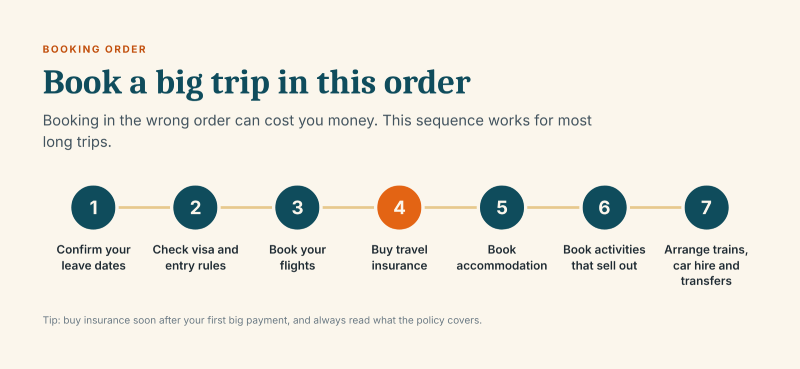
Buy insurance soon after your first big payment. Many policies include cancellation cover, so you are protected if something changes before you leave. Always read the policy to see what it covers.
Choose flexible or refundable rates where the price difference is small. On a trip planned months ahead, the freedom to change one hotel is worth a little extra.
Step 6: Sort Out the Paperwork Early
Check your passport first. Many countries will not let you in unless it is valid for several months after your trip, and renewals can take weeks.
Look up visa rules on the official government website of the country you are visiting. Check health advice too, as some destinations recommend or require vaccinations. Finally, tell your bank you are travelling and save copies of your documents on your phone.
Short Breaks vs One Long Holiday: A Simple Comparison
The table below compares three 4-day breaks with one 12-day trip. Both use twelve days in total. The numbers are an illustration, not a rule, so swap in your own.
| What you compare | Three 4-day breaks | One 12-day trip |
|---|---|---|
| Total days away | 12 | 12 |
| Days spent travelling | About 3 | About 2 |
| Full days at the destination | About 9 | About 10 |
| Return journeys to pay for | 3 | 1 |
| Times you pack and unpack | 3 | 1 |
| Destinations within reach | Close to home | Almost anywhere |
The gap in days looks small, but the feel is very different. Nine days split across three trips never lets you settle. Ten days in a row gives you time to slow down, change plans and still see what you came for.
The money side depends on where you go. A long-haul flight costs more than a short hop, so one big trip is not always cheaper. What it gives you is more real holiday time from the same days of leave.
How to Save Money for One Big Holiday
Saving for a long holiday is easier when the money has its own place. Open a separate savings account and name it after the trip. Set up an automatic transfer on payday so the money moves before you can spend it.
Work backwards from the total. If your trip costs 120,000 in your currency and you leave in ten months, you need to save 12,000 a month. If that is too much, move the date, shorten the trip or pick a cheaper destination.
Small swaps help too. Each time you skip a weekend away, move that money into the trip fund. You are not giving up travel. You are trading three small trips for one better one.
Paying in stages also spreads the cost. Flights come first, then accommodation, then activities. By the time you leave, most of the holiday is already paid for.
Common Mistakes to Avoid on a Long Trip
Even a well-planned big trip can go wrong in a few familiar ways. Watch out for these.
- Packing in too many places. Six cities in twelve days is a tour of train stations. Cut the list until every stop gets three nights.
- Choosing flights on price alone. A cheap fare with two long stopovers can eat a full day at each end. Compare total travel time as well as cost.
- Skipping the buffer. Without spare money, one small problem can spoil the mood for days.
- Booking every hour. A full schedule leaves no room for the café you find by accident, or for a slow morning when you need one.
- Coming home the night before work. Give yourself one quiet day at home to unpack, do the laundry and sleep. It makes the return to work much gentler.
Conclusion
One big trip beats three small ones when you plan it with care. You pay the fixed costs once, keep more of your days for the place itself and get months of happy waiting before you go. The method is simple: add up your budget, lock in your leave, choose a destination worth the time and stay at least three nights in every stop.
It is not the right choice for everyone, and a few short breaks may suit your year better. If the idea appeals to you, start small today. Write down what your last three trips cost. That number may be all the push you need to start planning something bigger.
Is one long holiday better than several short breaks?
One long holiday is better when you want to visit somewhere far away, travel slowly or fully switch off from work. Several short breaks are better when you cannot take long leave or need regular rests. A good mix is one big trip a year, plus a few day trips.
How far in advance should I book a big trip?
Start planning a big trip six to nine months ahead if you can. That gives you time to get leave approved, save in stages, renew a passport and apply for visas. Book flights and key accommodation once your dates are confirmed, and leave smaller bookings for the last few weeks.
How many days do you need for one big trip?
Ten to fourteen days is enough for most big trips. That length covers two travel days and still leaves time for three or four stops at a relaxed pace. For very distant destinations, where the journey takes a full day each way, two weeks or more is the better choice.
How many places should I visit on a two-week holiday?
Three or four places is a sensible limit for a two-week holiday. Staying at least three nights in each stop keeps packing and transfers to a minimum. If you are unsure, choose fewer bases and take day trips from them, rather than adding another hotel to the route.
Do I need travel insurance for a long trip?
Yes, travel insurance is well worth having on a long trip, because more money is at risk and more can change. Buy it soon after your first booking so cancellation cover starts early. Check that the policy covers medical care, delays, lost bags and every country and activity on your route.
Is one long holiday cheaper than three short trips?
One long holiday can be cheaper when it reduces repeated transportation and booking costs. Some accommodations also offer discounts for extended stays. However, the final price depends on the destination, season, and travel style. Compare complete budgets for both options before deciding which offers better value.
How many days are ideal for one big trip?
A holiday lasting 10 to 14 days can work well for travelers who want to explore several areas without rushing. Seven days may be enough for one destination. The ideal duration depends on travel distance, available leave, budget, and the number of places you want to visit.
What are the best destinations for a 10-day holiday?
Bali, Thailand, Vietnam, and Italy can be suitable for 10-day holidays because they offer varied attractions and experiences. The best destination depends on your budget, interests, departure location, and travel season. Choose a manageable route rather than trying to visit too many places.
Is slow travel better than visiting multiple destinations?
Slow travel can be better for people who enjoy relaxation, local culture, and flexible schedules. Staying longer in fewer places reduces frequent hotel changes and transportation time. However, travelers who enjoy exploring different cities may prefer a multi-destination itinerary. Neither approach is automatically better for everyone.