
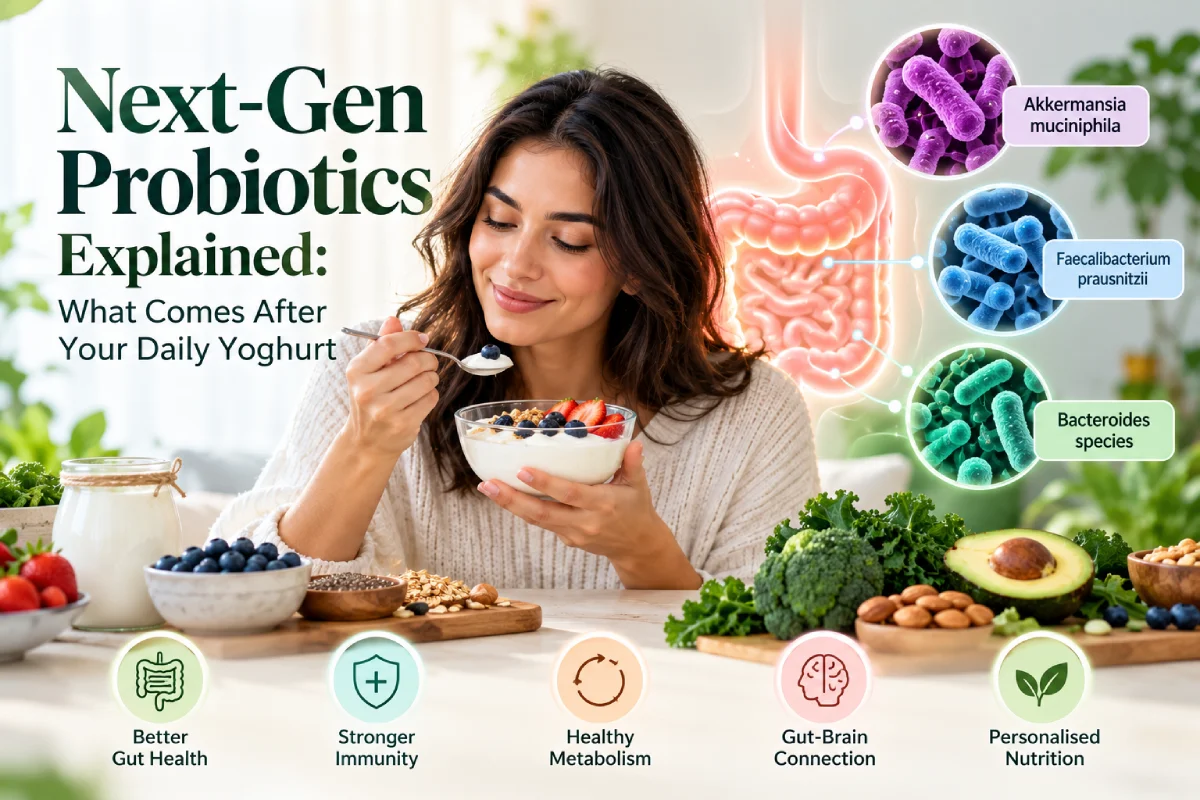
Probiotics are moving beyond the familiar bacteria found in yoghurt and traditional supplements. Next-generation probiotics are specific microorganisms being studied for targeted effects on the gut and wider health. Researchers are exploring organisms such as Akkermansia muciniphila, Faecalibacterium prausnitzii, and certain Bacteroides species.
The science is promising, but this field is still developing. Many next-generation probiotics are being investigated in laboratory studies and clinical trials rather than sold as routine probiotic foods or supplements.
Quick Facts
- What are they? Carefully selected microorganisms being studied for specific health functions.
- Are they the same as yoghurt probiotics? No. Traditional fermented foods usually contain familiar lactic acid bacteria, while next-gen probiotics may use very different gut microbes.
- Examples: Akkermansia muciniphila and Faecalibacterium prausnitzii are two widely researched candidates.
- Why are scientists interested? These microbes may interact with the gut barrier, immune system and metabolism.
- Can they replace yoghurt? Not necessarily. Yoghurt remains a nutritious fermented food and can contain live cultures.
- Are next-gen probiotics proven treatments? Generally, no. Evidence varies greatly by organism, strain and health condition.
- What comes next? More targeted probiotics, microbial combinations, postbiotics and microbiome-based therapies are being researched.
Table of Contents
The short answer
Next-gen probiotics are a new wave of gut bacteria that scientists have only recently learned to grow. They are not the Lactobacillus and Bifidobacterium strains found in your yoghurt. Researchers found them by comparing the gut bacteria of healthy people with those of people who have certain health conditions.
Early studies link them to steadier blood sugar and a stronger gut lining. But the science is young. Most of these bacteria have not been tested in large human trials.
So should you swap your yoghurt for a capsule? Not yet. This guide explains what these bacteria are, what the research really shows, and how to read the labels with a clear head.
What are next-gen probiotics?
Probiotics have an agreed scientific definition. They are “live microorganisms that, when administered in adequate amounts, confer a health benefit on the host”, according to the International Scientific Association for Probiotics and Prebiotics (ISAPP).
For decades, that meant a small group of familiar bacteria. Think of the cultures in yoghurt, kefir and most supplement capsules.
Next-generation probiotics, often shortened to NGPs, are different. They are bacteria that live naturally in the human gut but were never part of our food. Scientists spotted them using gene sequencing, then worked out how to grow them in a lab.
How they differ from the bacteria in yoghurt
| Traditional probiotics | Next-gen probiotics | |
| Where they come from | Fermented foods, the gut, breast milk | The human gut, found by comparing healthy and unwell people |
| Common names | Lactobacillus, Bifidobacterium, Streptococcus | Akkermansia, Faecalibacterium, Roseburia, Bacteroides |
| Oxygen | Cope well with handling and storage | Very sensitive to oxygen |
| Goal | General gut support | A specific health condition, strain by strain |
| How they are regulated | Sold as foods or supplements | May be treated as “live biotherapeutic products”, closer to medicines |
This comparison draws on a 2022 review in BioMed Research International.
Why you are only hearing about them now
The short reason is oxygen. Many of these bacteria die quickly when exposed to air. That makes them hard to grow, dry and pack into a capsule that still works months later.
Better lab methods are slowly solving that problem. As a result, the first products have started to reach shop shelves.
Probiotics, prebiotics, postbiotics: what is the difference?
The labels can be confusing. Here is each term in plain words, based on the ISAPP consensus definitions.
| Term | What it means | Everyday example |
| Probiotic | Live microbes that give a health benefit when you take enough | A capsule or yoghurt with a named, tested strain |
| Prebiotic | Food that your good gut bacteria use, with a proven benefit | Inulin, a fibre found in chicory root, onions and garlic |
| Synbiotic | Live microbes plus the food they use, in one product | A capsule that pairs a strain with a fibre |
| Postbiotic | Non-living microbes, or their parts, that still give a benefit | Heat-treated bacteria |
| Fermented food | Food made with the help of microbes | Yoghurt, kefir, kimchi, sauerkraut |
Is yoghurt a probiotic?
Not automatically. Yoghurt is a fermented food. It only counts as a probiotic when it contains specific strains, in a high enough amount, that have been shown to benefit health.
That does not make plain yoghurt a poor choice. It simply means the word “probiotic” has a stricter meaning than most labels suggest.
Where heat-treated bacteria fit
Some newer products contain pasteurised bacteria. These are no longer alive. Under the ISAPP definitions, that makes them postbiotics, not probiotics. This matters because one of the most studied next-gen products is a pasteurised one.
The next-gen strains worth knowing
Researchers are studying several candidates. The 2022 review highlights the ones below. Keep one thing in mind as you read. “Linked to” means scientists see a pattern. It does not mean the bacteria cause or cure anything.
Akkermansia muciniphila
This is the best-known name in the group. It lives in the mucus layer that lines your gut and feeds on that mucus. In doing so, it appears to help keep the gut barrier strong.
Studies link it to obesity, type 2 diabetes and other metabolic conditions. It also has the best-known human trial behind it.
Faecalibacterium prausnitzii
This bacterium produces butyrate, a short-chain fatty acid with anti-inflammatory effects. Research links it to inflammatory conditions and type 2 diabetes.
So far, the evidence comes mostly from animal studies. It is also extremely sensitive to oxygen, which makes it hard to turn into a product.
Other candidates in the pipeline
- Bacteroides fragilis: studied for its role in training the immune system.
- Eubacterium hallii: makes short-chain fatty acids and improved insulin sensitivity in mice.
- Roseburia species: another butyrate producer, with very little human data so far.
What does the evidence say so far?
The honest answer is: encouraging, but early.
The key human trial
The study most often quoted was published in Nature Medicine in 2019. Here is what it involved:
- Who: 40 overweight or obese adults enrolled, and 32 finished.
- What: 10 billion Akkermansia bacteria a day, either live or pasteurised, compared with a placebo.
- How long: 3 months.
Both versions were safe and well tolerated. The pasteurised version did best. Compared with placebo, insulin sensitivity improved by about 29%, and total cholesterol fell by about 9%.
Body weight dropped by about 2.3 kg, but that result was not statistically significant. In other words, it could have been down to chance.
The authors themselves called the study a “proof-of-concept”. It was small and short. It shows the idea is worth testing further, not that it works for everyone.
The rest of the research
For most other next-gen strains, the evidence is still in animals or early-stage trials. The 2022 review notes that long-term human safety data is limited and that effects depend on the exact strain.
It helps to remember that even traditional probiotics have gaps. The US National Center for Complementary and Integrative Health says that in most cases “we still don’t know which probiotics are helpful and which are not”.
What this means for you
- Metabolic health: the most promising area, based on one small trial.
- Weight loss: not proven. Be wary of any product that promises it.
- Gut comfort and immunity: too early to say for these newer strains.
Are next-gen probiotics safe?
For healthy adults, the early signs are reassuring. In the 2019 trial, people took Akkermansia daily for 3 months without safety problems. A 90-day toxicology study in rats also found no harmful effects from the pasteurised form.
In Europe, the food safety authority (EFSA) has assessed pasteurised Akkermansia as a novel food.
Still, three months and a few dozen people is not the same as years of everyday use. Long-term data simply does not exist yet.
Who should speak to a doctor first
- People with a serious illness or a weakened immune system. The NCCIH warns that the risk of harm from probiotics is greater in these groups.
- Parents of premature babies. Severe infections have been reported in this group.
- Anyone who is pregnant or breastfeeding, since these products have not been well studied in pregnancy.
- People taking medicine for diabetes, because these products are being studied for their effect on blood sugar.
A word on product quality
In many countries, supplements do not need approval before they go on sale. The NCCIH also notes that some probiotic products have contained microbes other than those on the label. Buying from a brand that publishes independent test results lowers that risk.
How to choose a next-gen probiotic
If you want to try one, a careful read of the label goes a long way.
What to check on the label
- The full strain name. Look for the genus, species and a strain code, not just “probiotic blend”. Benefits are specific to the strain.
- The amount per serving. It should be stated clearly, usually in cells or CFU.
- Live or pasteurised. Both exist. The label should say which one you are buying.
- Storage instructions. Oxygen-sensitive bacteria often need careful packaging or refrigeration.
- Independent testing. Third-party test results show the product contains what it claims.
- Realistic claims. Promises of fast weight loss or a “cure” are a red flag.
Do you still need your daily yoghurt?
Yes, if you enjoy it. Yoghurt gives you protein, calcium and live cultures at a fraction of the price of a specialist capsule.
Next-gen probiotics are not a replacement for food. Think of them as a possible extra, once the science catches up.
Simple ways to support your gut today
- Eat a variety of fibre-rich foods such as vegetables, pulses, whole grains and fruit. Fibre is what butyrate-producing bacteria feed on.
- Include fermented foods you like, such as yoghurt, kefir or kimchi.
- Give any new supplement a few weeks, and stop if you feel worse.
- Tell your doctor or pharmacist what you are taking.
Final Thoughts
Your daily yoghurt is not disappearing. But probiotic science is becoming far more sophisticated.
The future may involve carefully selected microorganisms, combinations of microbes and prebiotics, postbiotics and eventually more personalised microbiome interventions.
For now, the most useful approach is also the simplest: be curious about new microbiome science without treating every new probiotic as a proven medical breakthrough.
The next generation of probiotics is promising. The strongest products and treatments will be the ones that can demonstrate their benefits through high-quality human research not simply impressive marketing.
Medical note: This article is for general educational purposes and is not a substitute for personalised medical advice.
Sources
- ISAPP: A roundup of the consensus definitions of probiotics, prebiotics, synbiotics, postbiotics and fermented foods
- Next-Generation Probiotics: Microflora Intervention to Human Diseases, BioMed Research International, 2022
- Supplementation with Akkermansia muciniphila in overweight and obese human volunteers: a proof-of-concept exploratory study, Nature Medicine, 2019
- Toxicological safety evaluation of pasteurized Akkermansia muciniphila, Journal of Applied Toxicology, 2020
- NCCIH: Probiotics: Usefulness and Safety
Frequently asked questions
-
What is a next-generation probiotic?
A next-generation probiotic is a microorganism identified through modern microbiome research and investigated for a specific potential health benefit. Many candidates are natural residents of the human gut rather than traditional bacteria used to ferment foods.
-
Is Akkermansia better than a regular probiotic?
No one knows yet. The two have not been compared head to head. They also do different jobs, so one is not a straight upgrade on the other.
-
Can next-gen probiotics help you lose weight?
There is no solid proof. In the main human trial, people taking pasteurised Akkermansia lost about 2.3 kg more than the placebo group, but the result was not statistically significant.
-
Are postbiotics the same as probiotics?
No. Probiotics are alive. Postbiotics are non-living microbes, or parts of them, that still offer a health benefit.
-
Is yoghurt a probiotic?
Only sometimes. Yoghurt is a fermented food. It counts as a probiotic when it contains tested strains in an effective amount.
-
Are next-gen probiotics safe to take every day?
A 3-month trial found daily Akkermansia safe and well tolerated in adults. Longer-term data is limited. Check with a doctor first if you are pregnant, unwell or taking regular medicine.
-
Will probiotics eventually be personalised?
That is one direction of current research. Scientists hope microbiome, dietary and health data may eventually help match people with more appropriate interventions. However, personalised probiotic treatment is not yet routine clinical practice.